Spelling at Hillcross
At Hillcross, we follow the Phonics International scheme. For more information, please click on the tab to the right.
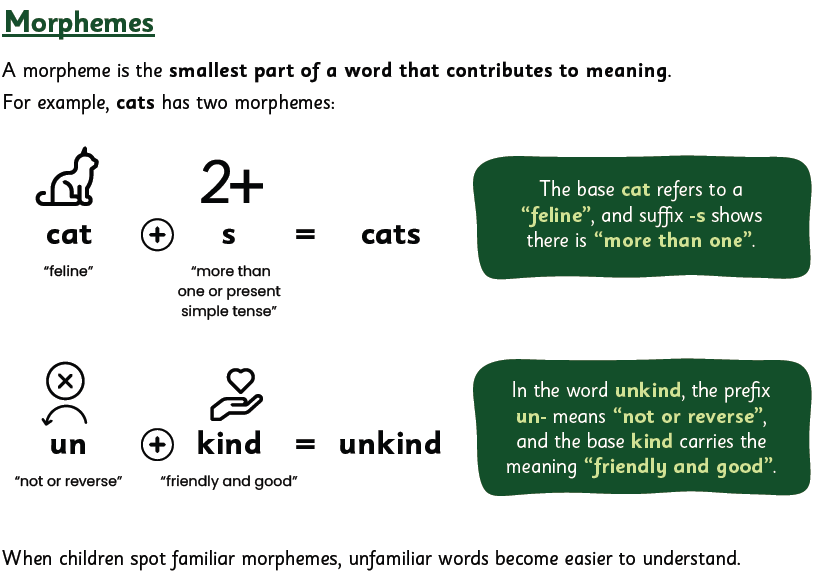
The teaching of spelling builds on the children’s phonological skills developed during the early stages of their literacy development. Building on this knowledge, from Year 2, children focus on the etymology and morphology in spelling, which means understanding where words come from and how words are made up of smaller parts called morphemes, such as:
- Base – the core part of a word that carries meaning (e.g. help, move, play)
- Affix – a morpheme that is either a prefix or a suffix
- Prefix – a part added before the base to change its meaning (e.g. un-, re-, mis-)
- Suffix – a part added after the base to change its form or meaning (e.g. -ed, -ing, -ful, -ness)
- Stem – a word part that includes a base and may also contain other morphemes (e.g. lovely, dangerous, laziness)
What will children be doing?
- Building words using bases, stems and affixes
- Learning the etymology of words – understanding their origins, historical roots, and language journey
- Exploring how morphemes change the meaning of words
- Using word matrices to see how one base can create many new words. A word matrix is a chart that shows how one base can grow into many new words using different prefixes and suffixes. It helps children see spelling patterns and deepens their understanding of word meanings
-
 Writing word sums
(e.g. runn + ing = running, help + ful = helpful, drive + er = driver)
- Directly applying new spelling knowledge in their writing units
- Learning four key spelling rules for adding suffixes:
- Double the final consonant letter when a word ends in a CVC pattern, then add the vowel suffix.
- Drop the final silent e vowel letter, then add the vowel suffix.
- Change the final letter y after a consonant letter to i, then add the suffix (except -ing).
- Just add the suffix.
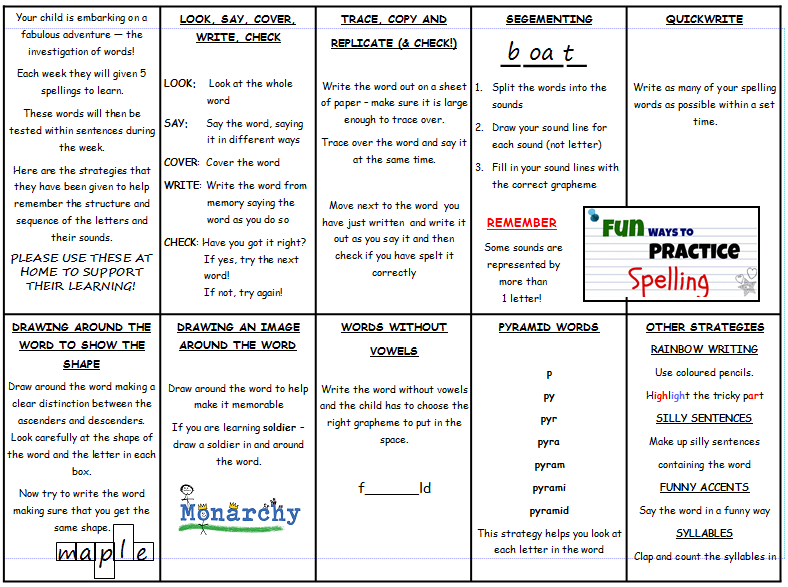
Great strategies to learn and practise words: