Writing
We have designed a bespoke, hybrid writing curriculum that synthesizes research-informed practices from leading educational thinkers: Pie Corbett (Talk for Writing), Jane Considine (The Write Stuff methodology), and Alan Peat (Exciting Sentences & Grammar Structures).
By unifying these approaches into a single cohesive framework, our curriculum guarantees that oracy is the foundation of all writing, skills progress sequentially from Nursery to Year 6, and every pupil—regardless of starting point—is equipped to write with authority, flair, and accuracy.
Children receive 'next step' feedback with teachers following our Feedback Policy. It is a very supportive and structured approach, so children gain confidence and know more to help them remember more.
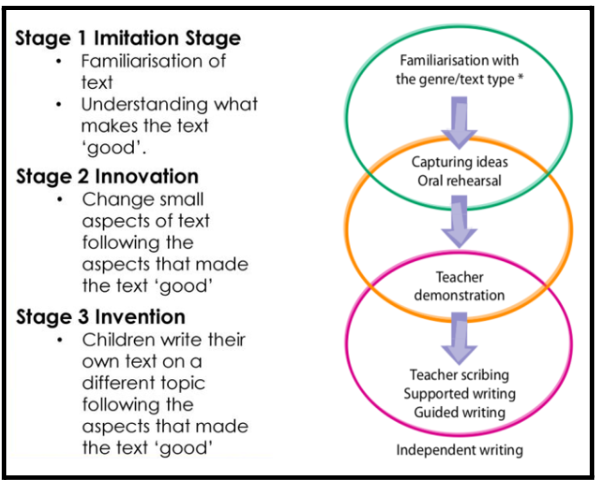
The writing process we follow for Narrative and Non-Fiction:
Children are challenged to write ‘Thinking Deeper’ sentences which requires them to independently draw upon previously learnt skills and apply them to their writing, including applying their own chosen grammatical features to achieve a particular effect.
To children see writing skills visually, we are using a ‘Writing Rainbow’ with these writing 'lenses' on. This will look slightly different in each year group to show the progression of writing skills in grammar (see links below).
Classroom Environments
Our classroom environment 'Working Walls' are designed to reflect current learning and could include 'Writer's Tookit of features and techniques, examples of grammar and sentence work and modelled writing. Please see below for some examples:
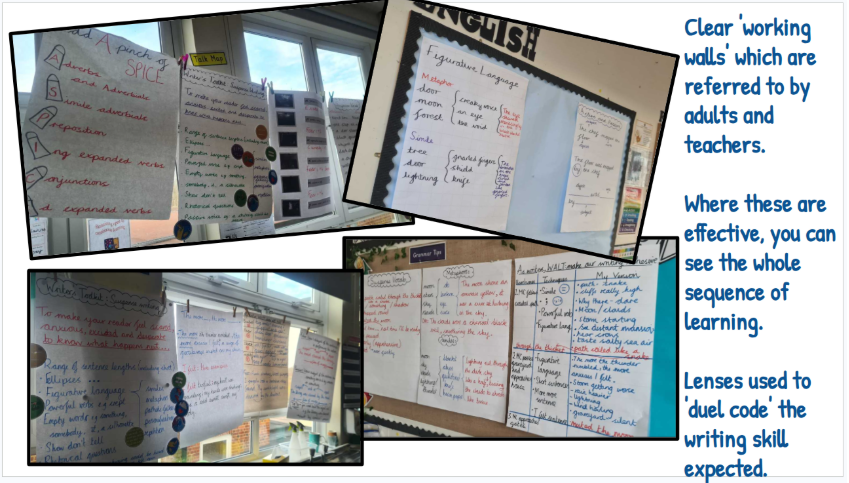
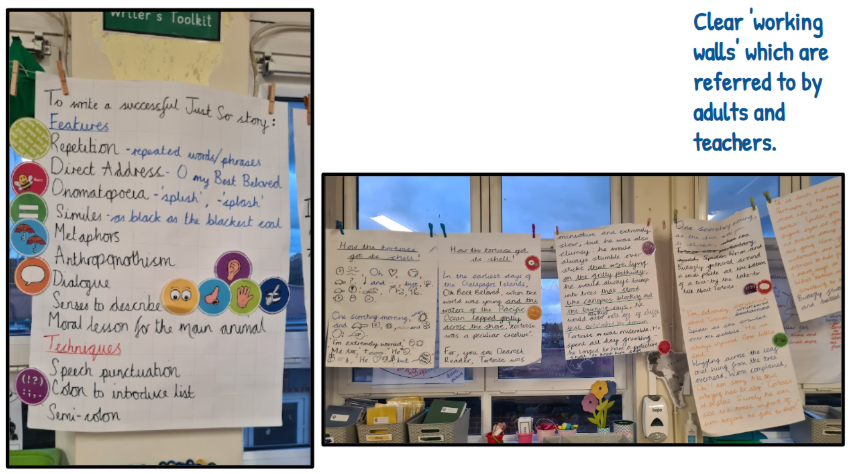
Following the explicit teaching of narrative and non fiction, children will have the opportunity to apply learnt skills to independent writing within the same genre. Therefore, every half term children will have an independent non-fiction and fiction piece of work completed in their assessed writing books.
‘What is important is that children are writing following the writing process each time they write, with time to evaluate what they’ve written, receive diagnostic feedback, and then make changes to improve it… Effective feedback, both oral and written, is how children learn to be better writers’
James Clements
Quick Writes
To promote a love of writing, Year 3-6 have a weekly Quick Write activity. A Quick Write is a brief, timed, and low-stakes writing activity designed to get thoughts onto paper without the pressure of perfect SPAG (Spelling, Punctuation, and Grammar).
The teaching of GRAMMAR
Every year, children in Years 2-6 are taught a sequence of lessons (which become progressively complex each year) allowing children to revisit and review 'the basics' of sentence construction. There is an opportunity at the end of each of these lessons for children to complete independent practice of the skill to inform teacher's assessment. Once this sequence of lessons on 'the basics' of grammar are complete, all year groups will follow the normal English curriculum for daily lessons.
On the Boil
To allow children to address misconceptions, there will be an 'On the Boil' grammar activity for children to complete at the start of each lesson. The purpose of this is for children to retrieve past learning whilst informing teachers' formative assessment.
Writing Progression
Using the National Curriculum expectations for grammatical skills being taught progressively in year groups, each year group follows a Writing Progression Overview. This details the purpose, genre and audience children will be writing for each half term (see links below).
In addition to this, we use 'Writing Progression Poster' which details all the necessary writing skills children need to be confident in by the time they reach the end of the year. They are stuck in the front of English books for children to refer to (see links below).